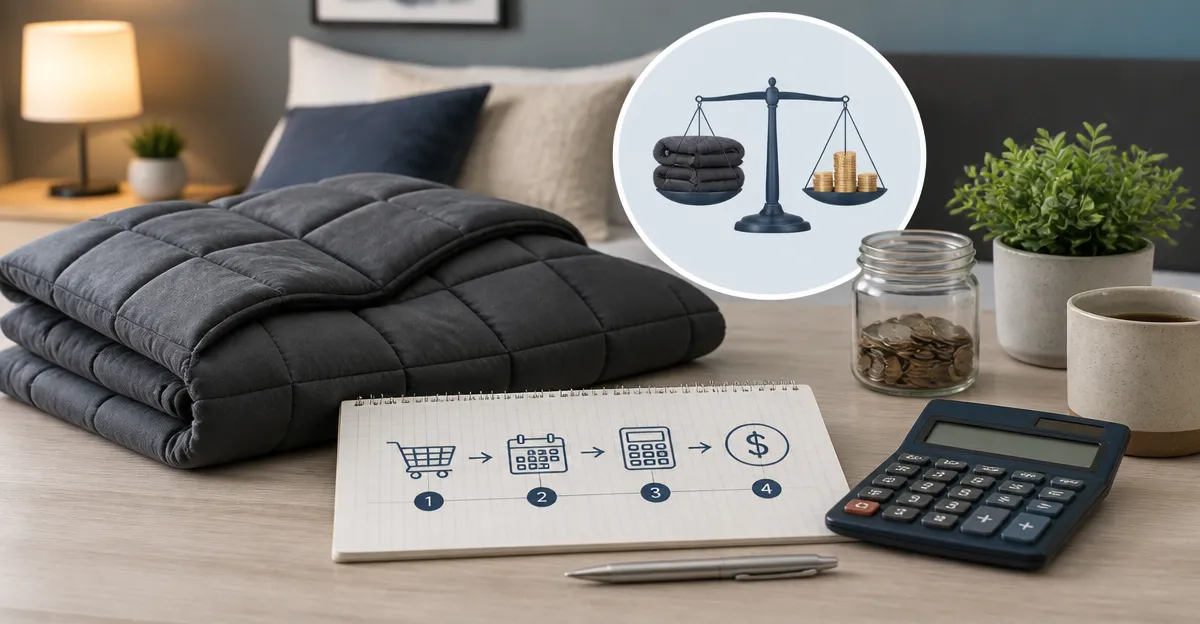
How to Calculate Weighted Blanket Cost Per Use: Step-by-Step Cost-Per-Use Calculator Guide
Introduction
Understanding the financial efficiency of a weighted blanket requires more than a simple price check. This guide teaches the reader how to determine the cost per use of a weighted blanket, enabling informed purchasing decisions. By applying a systematic calculation, one can compare the blanket against alternative sleep aids and assess long‑term value. The information presented is valuable for anyone seeking to balance comfort, health benefits, and budget constraints.
What You'll Need
- One weighted blanket, such as the Drewin Weighted Blanket
- Calculator or spreadsheet software (Microsoft Excel, Google Sheets, or a handheld calculator)
- Record of washing cycles and any repair incidents
- Access to the product specifications and warranty information
Step 1: Identify the Purchase Price
The first step in any cost‑per‑use analysis is to establish the initial outlay. The Drewin Weighted Blanket is priced at $50.99 and carries a rating of 4.7 out of 5 stars based on 851 reviews, indicating strong consumer satisfaction. Record this amount in the calculator as the baseline cost. This figure will serve as the numerator in the cost‑per‑use equation.
Step 2: Estimate the Expected Lifespan in Uses
Weighted blankets are typically constructed to endure several years of regular use. The Drewin model features a 7‑layer design with tightly stitched 6 × 6 grids that keep the glass beads evenly distributed, reducing wear. Manufacturers often suggest a lifespan of three to five years when the blanket is washed according to the care instructions. To convert years into uses, multiply the estimated years by the average weekly usage frequency; for example, a user who sleeps with the blanket five nights per week for four years would accumulate 5 × 52 × 4 = 1,040 uses.
Step 3: Account for Maintenance Costs
Maintenance expenses include laundering, occasional repairs, and replacement of the glass beads if necessary. The Drewin blanket is machine washable, allowing the owner to clean it without professional services, which minimizes additional cost. Assume a modest $5 per wash for detergent and electricity, and estimate the number of washes per year (e.g., 12 washes). Multiply $5 by 12 to obtain $60 annual maintenance cost, then add this to the original purchase price before dividing by total uses.
Step 4: Perform the Cost‑Per‑Use Calculation
With the data gathered, apply the formula: Cost per Use = (Purchase Price + Total Maintenance Cost) ÷ Total Uses. Using the example values, the total maintenance cost over four years equals $60 × 4 = $240. Adding the purchase price yields $50.99 + $240 = $290.99. Dividing $290.99 by 1,040 uses results in approximately $0.28 per use. This figure demonstrates that the blanket provides a high return on investment when compared with nightly sleep aids that require recurring purchases.
Step 5: Compare Against Alternative Solutions
To contextualize the $0.28 cost per use, compare it with other sleep‑enhancing products such as disposable eye masks or aromatherapy oils. A premium eye mask may cost $20 and require replacement every six months, resulting in a cost per night of roughly $0.67. Aromatherapy diffusers often involve recurring essential‑oil purchases that can exceed $1 per night. The weighted blanket therefore emerges as the most economical option for sustained comfort and therapeutic benefit.
Tips & Pro Tips
- Track actual usage in a simple log to refine the estimate over time; this improves accuracy.
- Rotate the blanket with a secondary one to reduce washing frequency, thereby lowering maintenance costs.
- Take advantage of the blanket's dual‑side fabric—plush sherpa on one side and jacquard sherpa on the other—to adapt to seasonal temperature changes without additional heating devices.
- Consider purchasing a protective cover; it extends the lifespan of the blanket and reduces the frequency of washes.
Troubleshooting
If the calculated cost per use appears unexpectedly high, verify the assumptions used for lifespan and maintenance frequency. Overestimating weekly usage or underestimating the number of washes can inflate the denominator or numerator, respectively. Adjust the variables to reflect realistic habits, and recalculate. In cases where the blanket develops noise from shifting beads, follow the manufacturer's recommendation to re‑stitch the grid or contact customer service for warranty assistance.
Conclusion
This guide has demonstrated how to calculate the cost per use of a weighted blanket through a clear, step‑by‑step methodology. By identifying the purchase price, estimating lifespan, incorporating maintenance costs, and performing the final division, the reader can quantify the financial efficiency of the blanket. The example using the Drewin Weighted Blanket shows that the cost per night can be as low as twenty‑eight cents, making it a compelling investment for improved sleep quality. Readers are encouraged to apply the calculator to their own usage patterns and make evidence‑based purchasing decisions.
Products Mentioned in This Guide
Frequently Asked Questions
How do I calculate the cost per use of a weighted blanket?
Divide the blanket's purchase price by the total number of uses you expect, factoring in washing cycles and any repairs.
What factors affect the total number of uses for a weighted blanket?
Durability, washing frequency, warranty length, and how often you sleep with it determine its usable lifespan.
Can I use a spreadsheet to track weighted blanket costs?
Yes, a simple spreadsheet can log purchase price, wash cycles, repair costs, and calculate cost per use automatically.
How does the cost per use of a weighted blanket compare to other sleep aids?
Weighted blankets often have a lower cost per use over time than disposable sleep aids because the upfront cost spreads across many uses.
Do warranty and repair expenses impact the cost‑per‑use calculation?
Include any warranty repairs or out‑of‑pocket fixes in the total cost before dividing by the number of uses for an accurate figure.