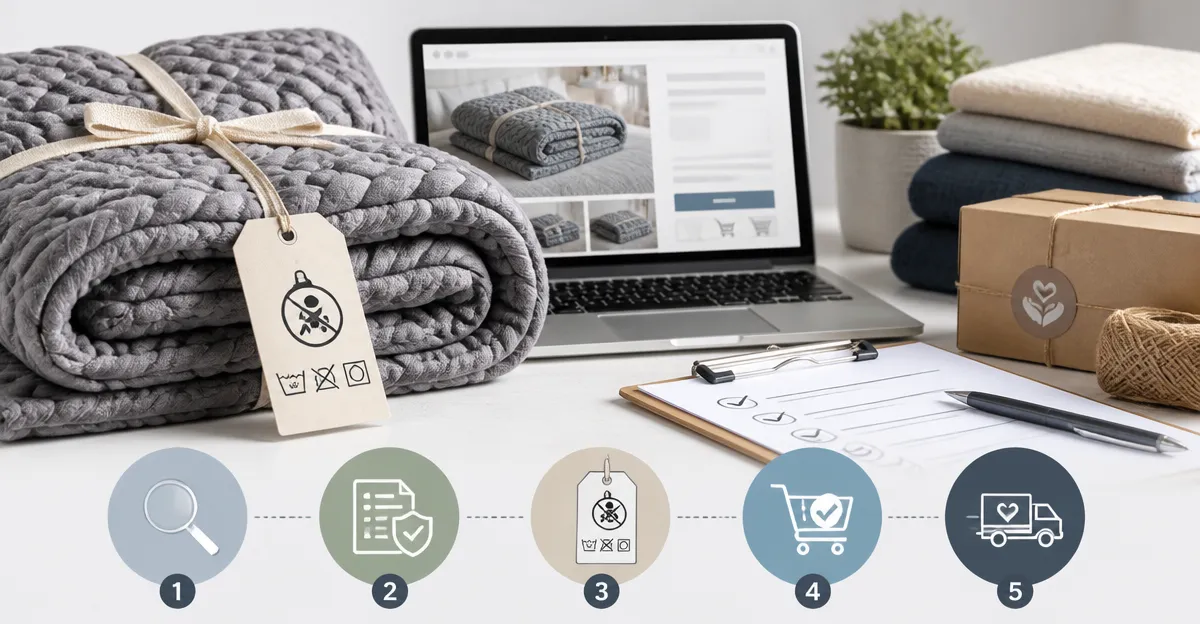
How to Sell Handmade Weighted Blankets Online: Complete Guide to Safety Labeling, Legal Compliance & Product Listings
Introduction
This guide explains how artisans can transform a handcrafted weighted blanket into a compliant, market‑ready product. Readers will discover the essential safety labels, legal requirements, and effective listing strategies that drive sales. By following each step, creators will avoid costly penalties while presenting a professional brand that customers trust. The information is actionable, practical, and supported by real‑world product examples.
What You'll Need
- High‑quality weighted blanket prototypes for testing (e.g., yescool 20 lb Weighted Blanket).
- Accurate scale for measuring weight distribution.
- Label printer or professional printing service.
- Digital camera or smartphone with good resolution.
- Access to an e‑commerce platform (Etsy, Shopify, Amazon Handmade).
Step 1: Research Regulatory Requirements
The first major step is to understand the regulations that apply to textile products in your target market. In the United States, the Consumer Product Safety Commission (CPSC) requires a General Certificate of Conformity (GCC) for weighted blankets that exceed 12 pounds. In the European Union, the REACH and CE markings address chemical safety and product conformity. Failure to comply can result in product recalls, fines, or removal from marketplaces.
Identify the specific weight range of your blankets; most handmade creators produce 15‑20‑pound models, which fall under the CPSC’s “heavy‑weight” category. Consult the CPSC website and local authorities to obtain the latest testing standards for fire resistance, flammability, and lead content. Document every source of fabric, filler, and thread to streamline future audits.
Why use a commercially available weighted blanket like the yescool 20 lb Weighted Blanket as a benchmark? It meets CPSC guidelines, includes detailed safety labels, and provides a real‑world example of compliant packaging. Examining its label layout saves time and reduces the risk of missing required statements.
Maintain a compliance folder—digital or physical—containing test reports, material safety data sheets (MSDS), and label drafts. This folder will be essential when applying for the GCC or when responding to marketplace inquiries.
Step 2: Design and Test Your Prototype
Create a prototype that mirrors the weight, dimensions, and stitching quality of successful market leaders. The Kivik 15 lb Queen Weighted Blanket demonstrates a 7‑layer design with high‑density stitching that prevents bead migration. Replicate a similar compartment size—typically 5" x 5"—to ensure even weight distribution.
Use a calibrated digital scale to verify that the total weight falls within 7‑10% of the intended user’s body weight. For a 200‑pound adult, a 20‑pound blanket is ideal; for lighter users, consider a 15‑pound version. Record the measurements in a spreadsheet for future reference.
Test durability by washing the prototype according to the care instructions found on the yescool 20 lb Weighted Blanket. Its claim of 50 successful machine‑wash cycles provides confidence that your own blanket can survive repeated laundering without bead leakage.
Gather feedback from a small group of beta testers. Ask about comfort, temperature regulation, and any noise from bead movement. Incorporate their insights to refine stitching, fabric choice, or filler type before moving to production.
Step 3: Create Accurate Safety Labels
Safety labels must include the product name, weight, dimensions, recommended user weight range, care instructions, and any hazard warnings. The label on the yescool 20 lb Queen Weighted Blanket lists a clear weight recommendation (7‑10% of body weight) and a machine‑wash warning, which you can emulate.
Design the label using a vector graphics program to ensure crisp text at any size. Include the FCC, CE, or GCC symbols as required by your jurisdiction. Use high‑contrast colors for readability; black text on a white background is standard.
Print the label on durable, tear‑resistant material such as polyester‑coated paper. Many small businesses outsource this to label printing services that guarantee compliance with ASTM standards. Keep a backup stock of printed labels for future batches.
Attach the label securely to the blanket’s edge or sewn into a corner seam, ensuring it will not detach during washing. Document the attachment method in your compliance folder.
Step 4: Photograph Your Product Professionally
High‑quality images are essential for converting browsers into buyers. Use natural light or a lightbox to avoid harsh shadows. Position the blanket on a neutral background that highlights its texture; the Wemore Fleece Weighted Blanket showcases its dual‑sided design effectively when photographed from both angles.
Capture at least three core shots: a full‑view lifestyle image, a close‑up of the stitching and fabric, and a detailed view of the safety label. Include a scale reference (e.g., a ruler or a person’s hand) to convey size.
Edit images using a free tool like GIMP or an online editor to adjust exposure and crop excess space. Avoid adding filters that misrepresent color; customers expect the blanket to match the product page.
Save images in JPEG format, optimized for web (72 dpi, under 1 MB each). Name files descriptively, such as "yescool‑20lb‑grey‑front.jpg" to improve SEO.
Step 5: Write Compelling Product Listings
Your listing should combine factual details with persuasive copy. Begin with a concise headline that includes the weight, size, and key benefit, for example: "20 lb Weighted Blanket – Cool, Breathable, Queen Size – Improves Sleep".
In the description, explain the science behind deep‑pressure stimulation, referencing the 7‑10% weight guideline. Mention the high‑density stitching (15,000 stitches per square inch) that prevents bead migration, a feature highlighted by the yescool 20 lb Weighted Blanket.
Include a bullet‑point list of key features: weight, dimensions, fabric type, machine‑washability, and safety certifications. Use the friendly product name when cross‑referencing competitor examples, such as the Kivik 15 lb Queen Weighted Blanket, to illustrate industry standards.
End the listing with a call‑to‑action encouraging customers to read the care guide and contact you for custom colors. Provide the estimated shipping time and any guarantee details.
Step 6: Set Up Your Online Storefront
Select a platform that supports custom product attributes and compliance documentation. Etsy and Shopify both allow you to upload PDF safety certificates and display them on the product page. Amazon Handmade requires a GCC number before activation.
Configure inventory tracking to avoid overselling, especially if you produce blankets in limited batches. Use SKU codes that embed weight and size information for quick reference.
Integrate a payment gateway that complies with PCI DSS standards, ensuring customer financial data is protected. Offer multiple shipping options, including tracked services for heavier items.
Test the checkout process from a buyer’s perspective to verify that taxes, shipping costs, and label information appear correctly.
Tips & Pro Tips
- Maintain a consistent brand voice across all listings; professionalism builds trust.
- Offer a small discount for bulk orders; many customers purchase multiple blankets for family members.
- Include a QR code on the safety label that links to a digital care guide; this reduces paper waste and enhances user experience.
- Monitor customer reviews for recurring concerns, such as bead noise, and adjust stitching density accordingly.
Troubleshooting
Problem: Beads leaking after washing.
Solution: Verify that each 5" x 5" pocket is sealed with double stitching; reinforce any weak seams before the next wash.
Problem: Blanket feels too hot in summer.
Solution: Offer a breathable cotton or bamboo cover; the yescool 20 lb Queen Weighted Blanket uses a cooling fabric that can serve as a model.
Problem: Listing is rejected for missing safety info.
Solution: Double‑check that the product name, weight, and user weight range are clearly stated in the title and description, and upload the GCC certificate.
Conclusion
By following this comprehensive guide, creators can launch handmade weighted blankets that meet safety standards, appeal to shoppers, and generate sustainable revenue. Proper research, prototype testing, accurate labeling, and polished listings form the foundation of a successful online business. Implement the tips, monitor compliance, and continuously improve based on customer feedback to stay ahead in a competitive market.
Products Mentioned in This Guide
Frequently Asked Questions
What safety labels are required for handmade weighted blankets sold online?
You must include a fire‑safety label, weight capacity warning, material composition, and a care‑instructions tag that meets CPSC or relevant regional regulations.
Which regulations govern the sale of weighted blankets in the United States?
The Consumer Product Safety Commission (CPSC) standards, ASTM F963 for fire safety, and any state-specific textile labeling laws apply.
How can I ensure my weighted blanket meets legal weight distribution requirements?
Test each blanket with a calibrated scale to verify the total weight and even distribution of internal beads or pellets, and keep documentation for compliance audits.
What are the best e‑commerce platforms for listing handmade weighted blankets?
Etsy, Shopify, and Amazon Handmade are top choices because they support custom product attributes, compliance checks, and have built‑in SEO tools.
How should I write product listings to improve SEO and attract buyers?
Include primary keywords like “handmade weighted blanket,” mention weight, size, and safety certifications, and use clear, benefit‑focused bullet points and high‑quality images.